
|
Why 26 January for ‘Australia Day’ when other dates are more significant nationally? Perhaps 3 March, or 9 July, with National Citizenship ceremonies on 17 Sept are more appropriate?
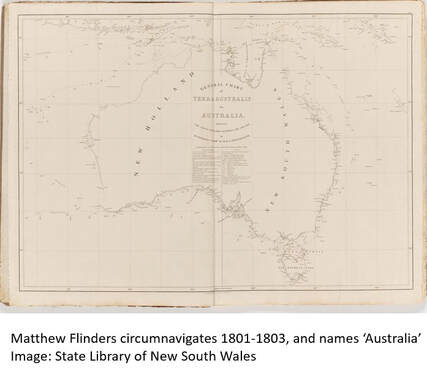
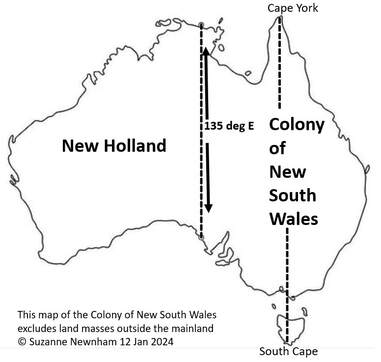
Map 1. While the original name 'Terra Australis' was used, the continent was not devoid of people. There is a 60,000 year history of habitation by First Nations (also known as indigenous, and aboriginal in historical to recent documents). Map 2. Colony of NSW took in the eastern side from Cape York [Queensland] to South Cape [Tasmania] through to 135degrees East, [South Australia], east of Coober Pedy (SA), Alice Springs (Northern Territory); west of Barkly Roadhouse (NT), north to Arnhem Land (NT). Brackets indicate current names of States and Territories. Other Maps not shown: from 1787 to 1910 can be seen at: https://www.heritageaustralia.com.au/articles/features/4576-a-nation-subdivided History – National; State, and Territory Days (compiled by Suzanne Newnham) National
Naming New South Wales 22 August 1770 “22 August [1770] at Possession Island, Cook once more 'hoisted English Coulers' and took possession of the whole eastern coast, later adding the name, New South Wales, in his journal.” https://adb.anu.edu.au/biography/cook-james-1917 Colony of New South Wales – eastern coast Day 7 February 1888 “The formal establishment of the Colony of New South Wales did not however occur on 26 January as is commonly assumed. It did not occur until 7 February 1788, when the formal proclamation of the colony and of Arthur Phillip's governorship were read out. The vesting of all land in the reigning monarch King George III also dates from 7 February 1788.[21][22][23] Although there was no official recognition of the colony's anniversary, with the New South Wales Almanacks of 1806 and 1808 placing no special significance on 26 January,[24] by 1808 the date was being used by the colony's immigrants, especially the emancipated convicts, to "celebrate their love of the land they lived in"[25] with "drinking and merriment".”[26] ” Wikipedia – Source: Elizabeth Kwan (25); Manning Clark (26) Anniversary Day (Sydney) - 26th January up to 1888 “For a long time 26 January was seen as a very NSW-centric holiday but Professor Darian-Smith said the concept of a national day became more prominent in the late 19th century. In 1888, there were celebrations in Sydney for Anniversary Day on 26 January to mark the centenary of the First Fleet's arrival.” https://www.sbs.com.au/voices/article/the-many-different-dates-weve-celebrated-australia-day/vuhb3ar1c Australia Day 30 July 1915 https://www.sbs.com.au/voices/article/the-many-different-dates-weve-celebrated-australia-day/vuhb3ar1c The first ever official national day that was actually named 'Australia Day'! On July 30 in 1915, the first official Australia Day was held, which was actually to raise funds for the World War I effort. https://www.awm.gov.au/articles/blog/the-other-australia-day-30-july-1915 While most of us associate Australia Day with 26 January, in 1915 that date was celebrated as Foundation Day and only in New South Wales, as each of the colonies had their own commemorations for their founding. During the First World War, the concept of a national ‘Australia Day’ was instead part of a wider fundraising plan where money was raised by declaring a special ‘day’ on which events such as auctions, stalls, performances and street collections were held to encourage the community to contribute to the war effort. Australia Day 26 January 1808, 1818, 1935 “Records of celebrations on 26 January date back to 1808, with the first official celebration of the formation of New South Wales held in 1818. It was not until 1935 that all Australian states and territories adopted use of the term "Australia Day" to mark the date of the 1788 landing of the First Fleet at Sydney Cove, and not until 1994 that 26 January was consistently marked by a public holiday on that day by all states and territories.[4” It was on 26 January that a landing was made at Sydney Cove and clearing of the ground for an encampment immediately began. Then, according to Phillip's account:[20] In the evening of the 26th the colours were displayed on shore, and the Governor, with several of his principal officers and others, assembled round the flag-staff, drank the king's health, and success to the settlement, with all that display of form which on such occasions is esteemed propitious, because it enlivens the spirits, and fills the imagination with pleasing presages. — The Voyage of Governor Phillip to Botany Bay” Day of Mourning, 26 January 1938 “In early January of 1938, Jack Patten and William Ferguson published the pamphlet titled Aborigines Claim Citizens Rights. The pamphlet described the conditions for Aboriginal people in Australia from their own perspective. It was published with the assistance of PR Stephensen, who also published the material in his own magazine The Publicists, and would later facilitate the publication of The Australian Abo Call. ‘The 26th of January, 1938, is not a day of rejoicing for Australia’s Aborigines; it is a day of mourning. This festival of 150 years’ so-called “progress” in Australia commemorates also 150 years of misery and degradation imposed upon the original native inhabitants by the white invaders of this country.” https://aiatsis.gov.au/explore/day-of-mourning Monday public holiday 1946 In 1946, the Commonwealth and state governments agreed to unify all the state-based Australia Day celebrations and celebrate on January 26 as a country - the public holiday was taken on the Monday closest to the 26th. Australia Act 3 March 1986 https://www.legislation.gov.uk/uksi/1986/319/introduction/made Australia Act 1986 is the short title of each of a pair of separate but related pieces of legislation: one an Act of the Commonwealth (i.e. federal) Parliament of Australia, the other an Act of the Parliament of the United Kingdom. In Australia they are referred to, respectively, as the Australia Act 1986 (Cth)[n 1] and the Australia Act 1986 (UK). These nearly identical Acts were passed by the two parliaments, because of uncertainty as to whether the Commonwealth Parliament alone had the ultimate authority to do so. They were enacted using legislative powers conferred by enabling Acts passed by the parliaments of every Australian state. The Acts came into effect simultaneously, on 3 March 1986. Wikipedia – Source: "Australia Act (Commencement) Order 1986" (PDF). Public holiday 26 Jan 1994 Australia Day officially became a public holiday for all states and territories only 24 years ago, in 1994. https://www.sbs.com.au/voices/article/the-many-different-dates-weve-celebrated-australia-day/vuhb3ar1c Constitution Day 9 July 2000 In lieu of 1 January as Federation Day, “Constitution Day was first held on 9 July 2000 to mark the centenary of the Constitution in the lead up to the Centenary of Federation. Constitution Day is observed on 9 July, the date Queen Victoria assented to the Commonwealth of Australia Constitution Act in 1900.[23] The date is not a public holiday.” Further events have not been widely held since 2001. The day was revived in 2007 and is jointly organised by the National Archives and the Department of Immigration and Citizenship.[24] Wikipedia – NAA source: https://www.naa.gov.au (‘Constitution Day’ 2000 to 2001) Australian Citizenship Day, 1948, 1969, 1973, 1984, 17 September 2001 * https://immi.homeaffairs.gov.au/citizenship/celebrating-citizenship/australian-citizenship-day # https://immi.homeaffairs.gov.au/citizenship-subsite/anniversary/Pages/citizenship-history.aspx *“17 September was chosen as Australian Citizenship Day as it is the anniversary of the renaming, in 1973, of the Nationality and Citizenship Act 1948 to the Australian Citizenship Act 1948.” # “1969, The Nationality and Citizenship Act 1948 is renamed the Citizenship Act 1948-69 and includes reduced residency requirements. 1973, the Citizenship Act is renamed the Australian Citizenship Act and preferential treatment for British subjects is removed. The same residency, good character, and language requirements applied equally to everyone. 1984, Australia repeal laws that made our citizens subjects of the United Kingdom. 2001, Australian Citizenship Day was introduced. 17 September was chosen as the date, representing the anniversary (in 1973) of the renaming of the Citizenship Act to the Australian Citizenship Act.” *“Australian Citizenship Day was first celebrated in 2001. The Australian Government established the day in 2001 in response to a recommendation by the Australian Citizenship Council in their 2000 report Australian Citizenship for a New Century. The recommendation came from a proposal of the 1999 National Schools Constitutional Convention that a citizenship day be established to allow all Australians to celebrate their Australian citizenship.” The day is an opportunity for all Australians to reflect on:
State and Territory Days NSW could celebrate its Day on 7 February or 22 August In keeping with founding days of other States and Territories Van Dieman’s land [Tasmania] 9 Jan 1826; Swan River Colony [not part of the Colony of NSW] 2 May 1829, WA 28 April 1831 (2 dates), SA 15 Aug 1834 Proclamation Day 28 Dec 1936; VIC 19 Nov1834, 8 Jun 1835; QLD [separate colony] 10 Dec 1859, 23 June 1862; NT 1911, Commonwealth to NT self-government 1978, NT appears to have different ‘Days’ per Darwin, or NT towns; Federal Capital Territory [FCT] 1 Jan 1911, Naming of Canberra 12 March 1913, FCT to Australian Capital Territory [ACT] 1938, Commonwealth to ACT self-government 1989 https://www.heritageaustralia.com.au/articles/features/4576-a-nation-subdivided https://monumentaustralia.org.au/themes /government/state/display/60289-centenary-of-western-australia; /landscape/settlement/display/99030-centenary-of-south-australia; /government/state/display/33647-centenary-of-victoria /government/state/display/107458-centenary-of-queensland /government/state/display/98029-centenary-of-the-northern-territory Tasmania https://www.britannica.com/place/Van-Diemens-Land https://www.heritageaustralia.com.au/articles/features/4576-a-nation-subdivided Van Diemen’s Land from New South Wales: The next significant change to British colonial holdings in Australia occurred on 9 January 1826 when the Sydney Gazette reported the separation of Van Diemen’s Land from New South Wales in the form of a proclamation dated 12 December 1825. The new colony encompassed “…the said Island and all Islands and Territories lying southward of Wilson’s Promontory, in Thirty-nine degrees and Twelve minutes of South Latitude…” https://en.wikipedia.org/wiki/History_of_the_Australian_Capital_Territory Source – NAA*; The Seat of Government Act 1908 fixed Canberra as the site of the new capital, and the surrounding region was formally ceded to the federal government on 1 January 1911. It was originally known as the Federal Capital Territory (FCT), adopting its current name in 1938.* When the Act came into force on 1 January 1911, control of the Territory was officially assumed by the Commonwealth. This Act remained the constitutional basis for law-making in the ACT until the granting of self-government in 1989.[77] Source: Carney, 2006 p.436-440 © Suzanne Newnham updated 12 January 2024
0 Comments
|

Author
|
 RSS Feed